A practical guide to choosing wall panels and ceiling materials for ISO Class 5, ISO Class 6, ISO Class 7, and ISO Class 8 cleanrooms
Cleanroom performance is not determined by air filtration alone. The materials used for walls, ceilings, doors, joints, and panel connections also play a major role in contamination control. In a cleanroom, every surface should help minimize particle generation, resist corrosion, support regular cleaning, and maintain a stable controlled environment.
In the U.S. market, cleanrooms are commonly classified using ISO 14644-1, which defines air cleanliness by airborne particle concentration. The FDA recognizes ISO 14644-1:2015 for classifying cleanrooms and clean zones by airborne particle concentration, while the older U.S. FED STD 209E terminology is still often used in daily industry conversations.
When selecting cleanroom wall and ceiling materials, the higher the cleanliness requirement, the more important it becomes to use smooth, non-shedding, easy-to-clean, and tightly sealed panel systems. Materials such as coated steel, stainless steel, anodized aluminum, and other non-shedding panel surfaces are commonly used in modular cleanroom systems.
Why Wall and Ceiling Materials Matter
Cleanroom performance is not determined by air filtration alone. The materials used for walls, ceilings, doors, joints, and panel connections also play a major role in contamination control. In a cleanroom, every surface should help minimize particle generation, resist corrosion, support regular cleaning, and maintain a stable controlled environment.
In the U.S. market, cleanrooms are commonly classified using ISO 14644-1, which defines air cleanliness by airborne particle concentration. The FDA recognizes ISO 14644-1:2015 for classifying cleanr
Cleanroom materials should not easily generate dust, fibers, rust, flakes, or loose particles. The room must be constructed to minimize the introduction, generation, and retention of particles, while also controlling conditions such as temperature, humidity, and pressure where required.
For walls and ceilings, this means the materials should provide:
- Smooth surfaces for easy cleaning
- Low particle shedding to reduce contamination risk
- Good chemical resistance for cleaning agents
- Corrosion resistance in humid or aggressive environments
- Dimensional stability to maintain panel flatness
- Sealed joints to reduce particle accumulation
- Strong ceiling support for lights, HEPA/ULPA filters, and utilities
This is why modular panel systems are widely used in cleanrooms. They help create cleaner joints, faster installation, and easier future modification compared with conventional construction.
ooms and clean zones by airborne particle concentration, while the older U.S. FED STD 209E terminology is still often used in daily industry conversations.
When selecting cleanroom wall and ceiling materials, the higher the cleanliness requirement, the more important it becomes to use smooth, non-shedding, easy-to-clean, and tightly sealed panel systems. Materials such as coated steel, stainless steel, anodized aluminum, and other non-shedding panel surfaces are commonly used in modular cleanroom systems.
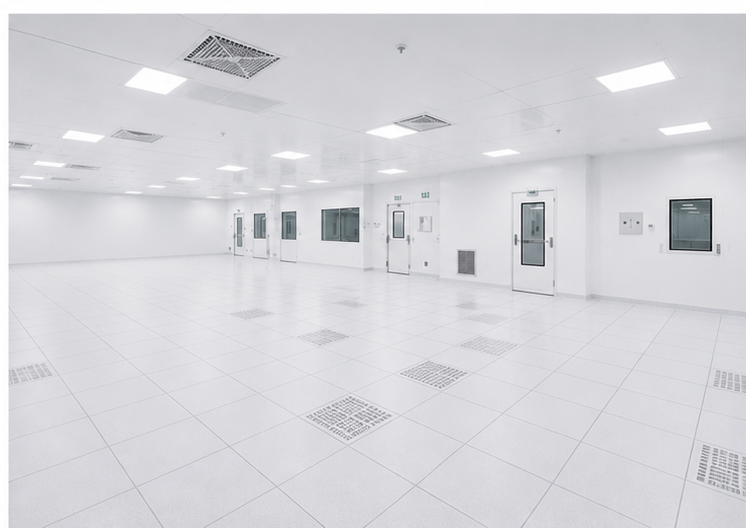
Cleanroom Wall and Ceiling Material Selection by Level
The table below provides a practical selection guide for common cleanroom levels in the U.S. market.
ISO Class 5: Critical Cleanroom Areas
ISO Class 5 cleanrooms are used where contamination control is extremely strict. In the U.S., this level is often associated with Class 100 terminology under the older FED STD 209E system. These environments may include pharmaceutical filling zones, semiconductor processes, advanced electronics, and critical medical device production.
For ISO Class 5 areas, wall materials should be extremely smooth, stable, and easy to clean. Stainless steel, coated aluminum, and aluminum honeycomb panels with cleanroom-grade coatings are strong options. Joints should be sealed carefully to reduce particle traps.
Ceiling systems must also perform at a high level. They often need to support HEPA or ULPA filters, lighting, sprinkler systems, and service access. For this reason, ceiling panels must provide strong rigidity, excellent flatness, and tight integration with the cleanroom grid system.
Aluminum honeycomb panels are especially valuable here because they combine lightweight handling with high stiffness. This helps reduce ceiling load while maintaining panel stability.
ISO Class 6: High-Control Manufacturing Areas
ISO Class 6 cleanrooms are still highly controlled, but typically offer more design flexibility than ISO Class 5. They are used in clean assembly, medical device manufacturing, electronics production, and controlled support areas.
Wall materials should still be smooth, cleanable, and non-shedding. Coated metal panels, aluminum honeycomb panels, and stainless steel-faced panels are common choices depending on the cleaning process and budget.
For ceilings, the material should support filter modules, lights, and maintenance access. Aluminum honeycomb ceiling panels are useful when the project requires a strong but lightweight ceiling system.
In ISO Class 6 cleanrooms, the key is to balance cleanliness, durability, and installation efficiency.
ISO Class 7: Common Medical, Pharmaceutical, and Industrial Cleanrooms
ISO Class 7 is one of the most common levels for controlled manufacturing. In older U.S. terminology, it is often compared with Class 10,000. It is commonly used in medical device production, pharmaceutical support areas, laboratories, and clean industrial assembly.
Wall systems at this level often use coated steel, aluminum panels, FRP-faced panels, or modular cleanroom panels. The goal is to create a cleanable, durable, and stable room envelope without overengineering the system.
Ceiling materials should match the airflow strategy. Some ISO Class 7 cleanrooms use conventional cleanroom ceiling grids with HEPA filter units, while others use modular panelized ceiling systems.
Aluminum honeycomb panels can be a strong fit when the customer wants better flatness, lighter weight, stronger rigidity, or a more premium modular system.
ISO Class 8: General Controlled Environments
ISO Class 8, often compared with Class 100,000 under the older U.S. system, is commonly used for packaging, gowning rooms, general clean manufacturing, and support spaces.
Because contamination control is less demanding than ISO Class 5–7, material selection may allow more cost-effective options. Coated metal panels, FRP panels, modular wall panels, or cleanable conventional wall systems may be suitable depending on the process.
Ceilings may use cleanable tiles, modular ceiling grids, or cleanroom ceiling panels. The main requirement is that the system should be cleanable, stable, and compatible with the airflow design.
For ISO Class 8 projects, aluminum honeycomb panels are not always required, but they can still provide advantages when the customer wants a more durable, lightweight, and long-lasting system.
| Cleanroom Level | Typical U.S. Equivalent | Recommended Wall Materials | Recommended Ceiling Materials | Selection Focus |
|---|---|---|---|---|
| ISO Class 5 | FED STD 209E Class 100 | High-performance modular wall panels with coated aluminum, stainless steel, or aluminum honeycomb panels with smooth cleanroom-grade surface finish. | Walkable or non-walkable cleanroom ceiling panels with sealed grid system, HEPA/ULPA filter integration, lighting support, and strong airtight detailing. | Maximum cleanliness, low particle generation, excellent cleanability, sealed joints, high dimensional stability. |
| ISO Class 6 | FED STD 209E Class 1,000 | Modular coated metal panels, aluminum honeycomb wall panels, or stainless steel-faced panels for areas requiring strong contamination control. | Cleanroom ceiling panels designed for HEPA filter units, lighting, and service access; aluminum honeycomb panels are suitable where light weight and rigidity are needed. | Clean surface, panel flatness, good sealing, durability, and easier maintenance. |
| ISO Class 7 | FED STD 209E Class 10,000 | Coated steel panels, aluminum panels, FRP-faced panels, or aluminum honeycomb panels for modular wall systems and controlled production areas. | Cleanroom ceiling tiles or modular ceiling panels with HEPA filtration layout, sealed joints, and compatibility with lights and mechanical systems. | Balance between cleanliness, cost, installation speed, and long-term durability. |
| ISO Class 8 | FED STD 209E Class 100,000 | Coated metal panels, FRP panels, modular wall panels, or cleanable gypsum-based systems depending on budget and process sensitivity. | Cleanable ceiling panels, standard cleanroom ceiling grids, or modular ceiling systems depending on airflow design and maintenance needs. | Cost-effective contamination control, cleanability, basic sealing, and practical maintenance. |
Where Aluminum Honeycomb Panels Fit Best
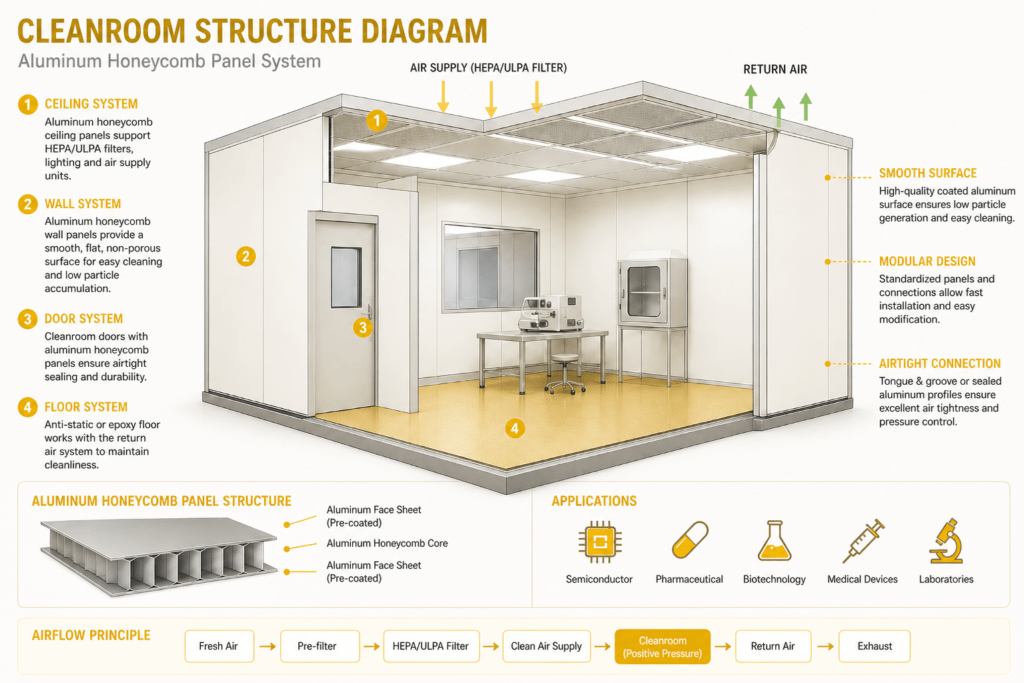
Aluminum honeycomb panels are not only a decorative material. In cleanroom applications, they can provide real engineering value.
Their main advantages include:
- Lightweight structure
The honeycomb core reduces overall panel weight while maintaining strong rigidity. - Excellent flatness
Flat surfaces are easier to clean and help reduce dust accumulation. - High rigidity
Wall and ceiling panels remain stable during installation and long-term operation. - Smooth, cleanable surface
With suitable surface treatment, aluminum panels can support contamination-control requirements. - Modular design compatibility
Honeycomb panels can be used in wall partitions, ceilings, doors, and equipment enclosures. - Reduced load for ceiling systems
This is especially useful where ceiling panels must integrate with filters, lights, and service components.
For cleanrooms that require long-term stability, premium appearance, and high performance, aluminum honeycomb panels are a strong material choice for both walls and ceilings.
Conclusion
Cleanroom material selection should always match the cleanliness level, industry requirements, cleaning process, airflow design, and project budget. ISO Class 5 and ISO Class 6 environments usually require stricter material control, smoother surfaces, better sealing, and higher-performance wall and ceiling systems. ISO Class 7 and ISO Class 8 environments may allow more flexibility, but cleanability and durability still matter.
For many cleanroom projects, aluminum honeycomb panels offer an ideal balance of light weight, high rigidity, smooth surface quality, and modular construction efficiency.
If you are planning a cleanroom project and need aluminum honeycomb panels for walls, ceilings, doors, or modular systems, contact Ulike for a quote or further cooperation.